WhatsApp broadcast without getting blocked: what a broadcast is on the Platform, the four faults that end a number, and how to send one that works
A marketing template to people who opted in, at Meta's rate, counted against the messaging limit. A list that did not ask, a message every few days, no STOP line and a category that lies are what get a number restricted; the fix is the audience.
Rates and limits verified against Meta's published pricing on 19 September 2026 · Meta's page
A WhatsApp broadcast on the Business Platform is a marketing template sent to a list of people who opted in, at Meta's per-message rate. The ones that get a number blocked or its messaging limit frozen share four faults: a list that did not ask, a message every few days, no STOP line, and a template that pretends to be a receipt. Send to people who said yes, once a week at most, with a way out in every message, and watch the quality rating.
On this page
What a broadcast is on the Platform
Not the phone app's broadcast list of 256 saved contacts. On the Platform a broadcast is a marketing template sent to an audience, each message charged at ₹0.8631 in India plus GST, delivered only to people whose numbers are on WhatsApp, and counted against the number's daily messaging limit. There is no cap on the audience beyond that limit, and no requirement that they have saved you — only that they opted in.
The four ways a broadcast ends a number
- The list did not ask. A purchased database, a scraped list, an exhibition's sign-in sheet from two years ago. The blocks arrive in the first hour, the quality rating goes yellow the same day, and the messaging limit stops rising. Meta's rule and India's DPDP Act both require an opt-in that named you and WhatsApp.
- Too often. Three messages a week to the same person is a block by the second week. Once a week is the ceiling; once a month is normal for most businesses.
- No way out. A message with no STOP line is reported rather than declined. A STOP that does not work is reported twice.
- A category that lies. A sale dressed as "your order update" is reclassified by Meta, the template is paused, and the number's rating drops with it.
What the rating does to you
Green, yellow, red, from the last seven days of blocks and reports. Yellow stops the messaging limit rising; red pauses templates and can restrict the number. The limit itself — 250 a day unverified, then 1,000, 10,000, 100,000 — only rises while the rating is green and you are using half of it. A broadcast that goes wrong is not one bad campaign; it is a smaller number for the next month. The quality rating guide has the mechanics.
A broadcast that works
- Audience built from consent, not from contacts: the people who ticked the WhatsApp box, replied YES, or messaged you and said yes to offers — with the source and the time on record.
- Segmented by what they told you. A launch to the leads whose brief it matches; a lane rate to the shippers on that lane; a new batch to the families who asked about that course. Never everything to everyone.
- One message, one purpose, a real reason to reply — a question, an offer with a date, a thing they asked about.
- A STOP line in every message, honoured at once in every language, everywhere.
- Sent at a sensible hour, and stopped for anyone who replies — a person in a conversation is not a person in a campaign.
- Measured on replies and deals, not on delivered.
In Linkubit
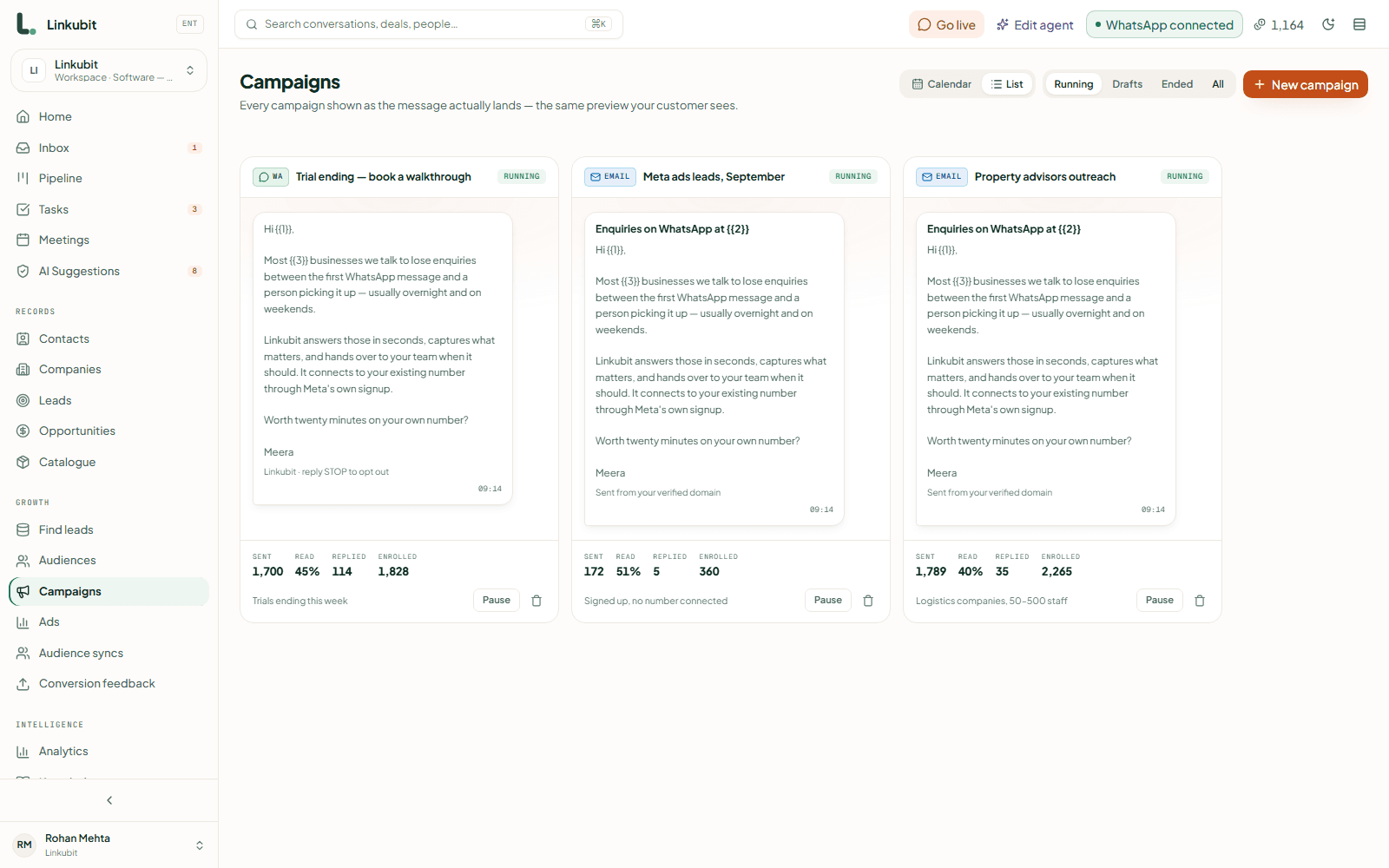
A campaign's audience is built from consent records, every send passes the same gate that checks consent, suppression and the channel's rules, a reply on any channel cancels the rest of the sequence for that person, and STOP in any language suppresses them everywhere in the same second. There is no way to send to a list that did not opt in, because the gate is the only path a message can take.
How many people can I broadcast to on WhatsApp?
As many as your number's daily messaging limit allows — 250 unverified, then 1,000, 10,000, 100,000 and unlimited as the tier rises — and only those who opted in. The phone app's 256-contact limit does not apply on the Platform.
Why did my template get paused?
Enough recipients blocked or reported it. Meta pauses a template for three hours, then six, then disables it. The fix is the audience, not the wording: send to people who asked.
How much does a WhatsApp broadcast cost?
Meta's marketing rate per delivered message — ₹0.8631 in India, plus GST — and whatever the software charges. Linkubit adds nothing to Meta's rate and meters a campaign message at a tenth of a credit.
Read next
More on Getting and keeping leadsLinkubit vs other toolsWhatsApp templatesCost calculatorPricing
Try it on your own number. Linkubit answers, qualifies and quotes on WhatsApp from your catalogue, and adds nothing to Meta’s per-message price. Start free — fourteen days of Pro, no card — or read the pricing.