AI sales agent vs WhatsApp chatbot: what a flow, an assistant and an agent each do when the conversation leaves the script
A chatbot follows a flow and fails outside it. An assistant answers from documents. An agent pursues a goal — qualify, quote, book — with rules enforced outside the model. Which one a business needs, and the failure mode of each.
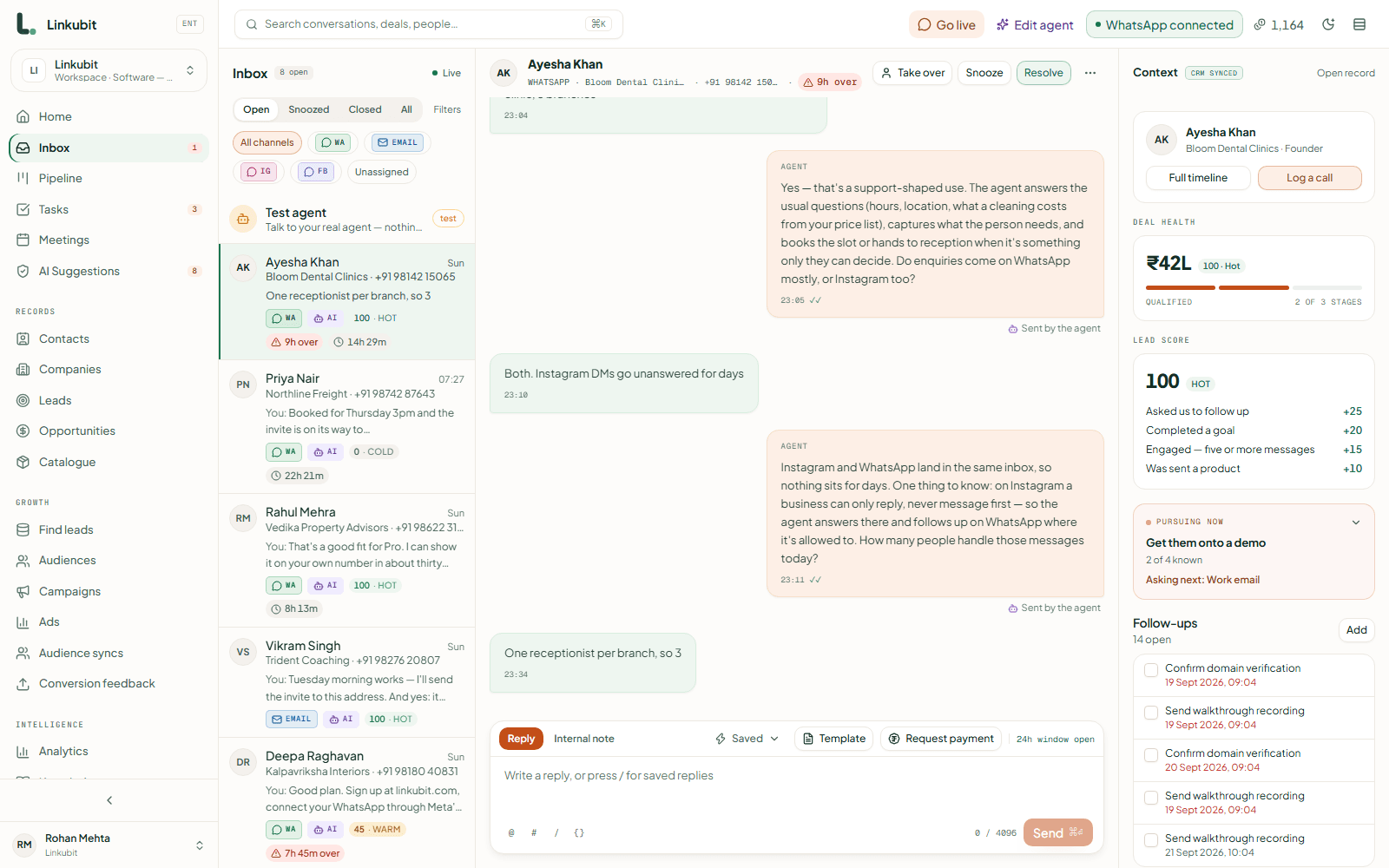
A WhatsApp chatbot follows a flow somebody drew: keyword, button, next node. An AI assistant answers questions from a knowledge base. An AI sales agent does what a salesperson does — asks what the customer needs, writes it down, quotes from the catalogue, books the next step and hands over when it should — and is only safe to run if its rules live outside the model. The difference shows in the first conversation that leaves the script.
On this page
Three things sold under one name
| Chatbot (flows) | AI assistant | AI sales agent | |
|---|---|---|---|
| How it decides what to say | A flow you drew: keyword → node → buttons | A language model answering from documents | A language model with a goal, a schema of fields to capture, tools it may use, and rules that gate them |
| A question the script did not expect | "Sorry, I didn't understand. Press 1 for…" | An answer, if a document covers it | An answer, a question back, or a handover — and the answer is written onto the lead |
| A price | Whatever was typed into the node | Whatever the documents say, possibly out of date | The catalogue's, or nothing |
| When a person takes over | When the flow ends or breaks | When the customer asks | When a rule says so — a topic, a value, a missing field — before the reply exists |
| What is left afterwards | A transcript | A transcript | A qualified lead with the fields filled, a deal at a catalogue price, a next step on the pipeline |
Why flows stop working
A flow is a map of the conversations you imagined. Customers have the ones they want: they answer two questions in one message, ask the price before the model, switch to Hindi, send a voice note, or reply "ok" to a question that needed a number. Every one of those is a node nobody drew, and the bot's only move is to say it did not understand. The teams that run flows well spend their time drawing more nodes; the customers they lose are the ones who did not press 1.
Why an assistant is not enough
An assistant that answers from documents solves the "did not understand" problem and creates two more. It answers from whatever the documents say, so a price list from March is quoted in September. And it answers — that is all it does. The customer who asked three good questions is no closer to a booking, and nothing about them was written down. It is a better FAQ, not a salesperson.
What makes it an agent
- A goal. "Qualify this enquiry and book a visit" — not "be helpful".
- Fields to capture. The four to six things your business needs before a quote is worth writing, asked one or two at a time and written onto the record as they arrive.
- Tools, and a gate before each one. Look up a product, write a field, propose a slot, request a payment — each a capability the agent may or may not have, checked in code before it runs.
- A source of truth for prices. The catalogue. A price that is not there is not quoted.
- A handover rule. Topics, values and situations that go to a person before the agent replies, with everything captured so far attached.
- A verifier on the way out. Every reply checked against what the agent actually retrieved before it sends.
Where the rules live matters more than the model
An agent whose rules are lines in its prompt follows them most of the time. An agent whose rules are code — a gate before every tool call, a gate before every send, a verifier on every reply — follows them every time, because the model is never the last thing between a decision and the customer. The rules guide goes into how Linkubit does this.
Which one you need
- A flow if the conversation genuinely has four branches and a person is always on the other end of the fourth — a delivery status bot, a menu.
- An assistant if the job is answering questions about a fixed body of content and nobody needs to be sold anything.
- An agent if a conversation ends in a quote, a booking, a payment or a qualified lead — and if the cost of a wrong price or a missed handover is real. That is what Linkubit is, and the features page lists what it does and does not do.
Is an AI sales agent the same as a WhatsApp chatbot?
No. A chatbot follows a flow you drew and fails outside it. An AI sales agent pursues a goal — qualify, quote, book — asks its own questions, writes the answers down, and hands over when a rule says so. The failure modes are different: a chatbot says it did not understand; an unruled agent says something it should not.
Can an AI agent replace a salesperson?
It replaces the first minute, the qualifying questions, the catalogue quote, the reminders and the paperwork — the parts a salesperson does forty times a day and a customer waits an hour for. It hands the negotiation, the judgement call and anything sensitive to a person, with the record already filled in.
How much does an AI sales agent cost on WhatsApp?
In Linkubit, one credit per reply, with a monthly allowance on every plan including Free; Meta's per-message charge on top, unchanged. Several other platforms sell the AI as an add-on per thousand messages — the comparisons show the figures.
Read next
More on Selling with an AILinkubit vs other toolsWhatsApp templatesCost calculatorPricing
Try it on your own number. Linkubit answers, qualifies and quotes on WhatsApp from your catalogue, and adds nothing to Meta’s per-message price. Start free — fourteen days of Pro, no card — or read the pricing.