Qualifying leads on WhatsApp: the four to six questions, the order to ask them, and where the answers have to go
Why quote after the brief, not before. The questions by industry — freight, property, coaching, clinics, D2C, travel — how to ask them two at a time in the customer's language, and why the answers belong on a record rather than in the chat.
Qualifying a lead on WhatsApp means getting the four to six facts your business needs before a quote is worth writing — asked one or two at a time, in the customer's language, inside the free window, and written onto the record rather than left in the chat. The order matters: the questions that decide whether the enquiry is real come first, the ones that shape the price come next, and the pitch comes only after.
On this page
Why qualify before you quote
A quote sent before the brief is known is a quote redone — or worse, a quote the customer uses to rule you out. Three 3 BHK options to a family with a 2 BHK budget, a container rate to someone shipping two pallets, a JEE fee card to a class 8 parent: each cost a day and the customer's confidence. The facts that stop that are few, and they are the same for every enquiry your business gets. Write them down once; ask them every time.
The four to six questions
Every business has its own set. The pattern across them is the same: one question that tells you whether this is a real enquiry, two or three that shape what you will quote, and one or two about timing and who decides.
| Business | Real? | Shapes the quote | Timing and decision |
|---|---|---|---|
| Freight forwarder | Running monthly volume, not a one-off | Origin, destination, mode, commodity | First shipment date; Incoterm |
| Real estate | Budget, all-in | Configuration, locality, ready or under construction | Move-in date; loan; decision maker |
| Coaching institute | Class and exam | Mode, batch timing | Start date; who is deciding |
| Clinic | Which doctor or treatment | New or returning; insurance | Preferred days; urgent? |
| D2C store | Which product and size | Pincode; prepaid or COD | Gift or bulk? |
| Travel agency | Travel dates | Travellers and ages; budget per person | Flights or land only; visa status |
How to ask
- One or two at a time. A form of six questions in one message gets one answer or none. Two questions get two answers.
- In the first reply, and inside the window. The customer is on their phone; the answers are free. An hour later they are a template, charged, to someone who moved on.
- In their language. A question in Hindi to a message in Hindi. A voice note answered as text, in the language of the note.
- Restating what they said. "You mentioned Whitefield — is Marathahalli also fine?" proves the message was read, which is why they answer.
- Accepting partial answers. "Not sure" on Incoterm is a useful answer. Write it down and move on.
Where the answers go
Not in the chat. A qualified lead is one whose fields are filled on a record a report can find: the budget in the budget field, the timeline in the timeline field. That is what lets a rule block the shortlist until the budget is known, lets a score rank the lead, lets a rep act on it in one look, and lets a manager see how many of last week's enquiries were real. A transcript with the same facts in it does none of that.
In Linkubit
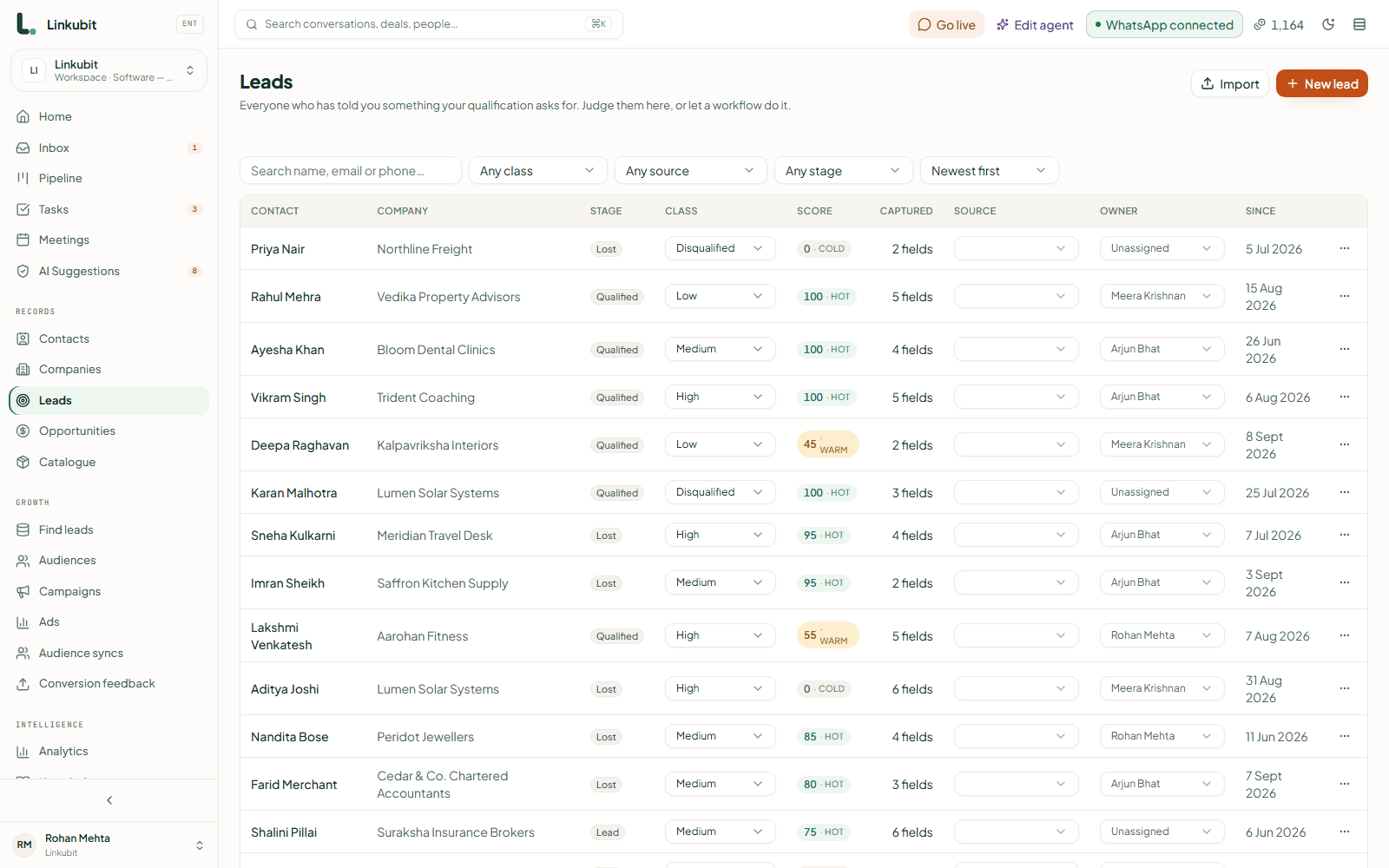
The questions are a schema you edit — the fields, the order, which ones are required before which action. The assistant asks them in the customer's language and writes the answers onto the lead as they arrive; a rule blocks the quote until the required ones are filled and names the missing field; scoring reads the fields; the lead reaches qualified on the pipeline when the goal completes. None of it is specific to an industry, which is why a freight forwarder and a dental clinic run on the same system.
When to stop qualifying
When you have what the quote needs. A seventh question is friction. And when a person should take over: a budget above a threshold, a complaint, a request for a discount, a hazardous commodity — a rule that hands the thread to a person before the assistant replies, with everything captured so far, is part of qualification, not a failure of it.
How many questions should I ask a lead on WhatsApp?
Four to six, over two or three messages, and only the ones that change the quote or decide whether the enquiry is real. More than that is a form, and forms are not answered on WhatsApp.
Should I qualify before sending the brochure?
Yes. The brochure is the pitch; sent before the brief it is either wrong or ignored. Send the thing they asked for — three options that fit — after budget and size are known.
Can an AI qualify leads?
Yes, and it is the part it does best: it asks the same questions every time, in the customer's language, in the first minute, and writes the answers down. It hands over the moment a rule says a person should decide.
Read next
More on Selling with an AILinkubit vs other toolsWhatsApp templatesCost calculatorPricing
Try it on your own number. Linkubit answers, qualifies and quotes on WhatsApp from your catalogue, and adds nothing to Meta’s per-message price. Start free — fourteen days of Pro, no card — or read the pricing.