When an AI should hand a WhatsApp conversation to a human: the triggers, the handover that works, and what not to hand over
Hand over on a rule — a topic, a value, a missing capability, sentiment, a flood — before the reply, not after a wrong one. What the person needs to see, why the agent stays silent until handed back, and the ten percent that should be a person's.
An AI agent should hand a WhatsApp conversation to a person when a rule says so — a topic, a value, a missing field, a sentiment — before it replies, not after a wrong reply. The handover must be explicit in both directions: the agent stops until a person hands back, and the person sees the whole thread with every field the agent captured. A handover that depends on the customer typing "agent" is one that happens too late.
On this page
The wrong model of handover
Most chatbots hand over when the customer asks for a human or when the flow runs out. By then the bot has usually said the wrong thing twice. A handover is a decision about the *conversation*, and it belongs before the reply: the agent reads the message, a rule fires, and a person answers instead — with the customer never seeing the agent try.
When a person should answer
| Trigger | Example | Why a person |
|---|---|---|
| A topic | Hazardous cargo; a symptom; a legal threat; a complaint about a delivery | The cost of a wrong answer is not a lost sale |
| A value | A requirement above 50,000 sq ft; an order above ₹5 lakh; a discount request | Negotiating leverage is the product |
| A missing capability | "Can you build a custom itinerary?"; "Can you match this competitor's quote?" | The agent has no tool for it, and should say so by handing over rather than improvising |
| Sentiment | Anger, a second "I already told you", a threat to leave | A person de-escalates; a model repeats |
| A flood | Forty messages in ten minutes on one thread | Something is wrong, and it is not a sale |
| The customer's ask | "Can I talk to someone?" | Always, immediately, without a form |
What a good handover looks like
- Before the reply. The rule runs on the inbound message. The agent's turn is skipped; nothing is sent.
- Visible to the person. The thread lands in a queue with a reason — "handed over: hazardous cargo" — and every field the agent captured, so the person does not ask the customer to repeat themselves.
- Silent until handed back. The agent does not resume because the customer wrote again. A person hands back, explicitly, and the agent picks up with the thread's history.
- Honest to the customer. "Priya from our team will take this from here" — a name, and a time if it will be a while. Not silence, and not a bot pretending.
- Recorded. The handover is an event on the timeline: who, when, why. It is how you learn which rules fire and which should.
In Linkubit
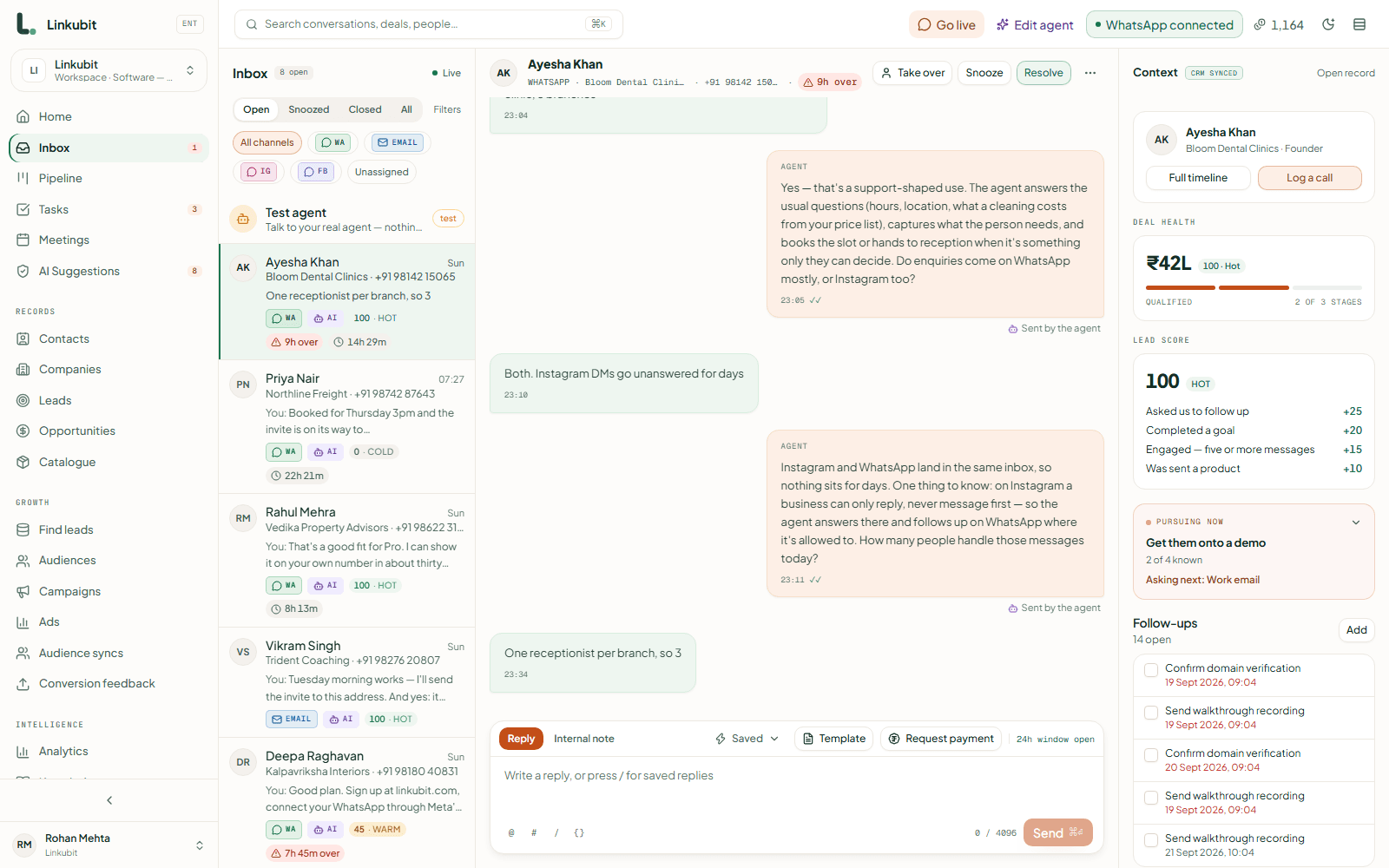
A handover is a rule effect enforced in code before the agent's turn: a topic, a field value, a contact attribute, or the customer asking. The conversation's mode flips to human, the agent is skipped on every turn until a person hands back from the inbox, and the person sees the thread, the captured fields and the reason. A flood of more than forty inbound messages in ten minutes hands over on its own. Meta's human-agent tag, which extends the reply window to seven days, is set only on a message a person actually wrote — never on the agent's.
What not to hand over
The first minute, the qualifying questions, the catalogue quote, the visit confirmation, the reminders, the document list, the payment request. These are the forty-times-a-day tasks a person does slower and later. A team that hands everything over has a chatbot with extra steps; the point of the rules is to hand over the ten percent that needs judgement and keep the person for those.
Should customers know they are talking to an AI?
Yes. The assistant introduces itself as the business's assistant, and the handover names the person. Pretending is a policy problem with Meta and a trust problem with the customer.
What if a person is not available?
The thread waits in the human queue and the customer is told a person will reply and roughly when. The agent does not fill the gap with guesses; a handover that expires back to the agent is a rule that does nothing.
Can the customer trigger the handover?
Always — "talk to a person", "agent", "human", in any language, hands over at once. The rules exist for the cases where the customer would not have asked.
Read next
More on Selling with an AILinkubit vs other toolsWhatsApp templatesCost calculatorPricing
Try it on your own number. Linkubit answers, qualifies and quotes on WhatsApp from your catalogue, and adds nothing to Meta’s per-message price. Start free — fourteen days of Pro, no card — or read the pricing.