One inbox for WhatsApp, Instagram DMs, Messenger and email: how a small team answers every channel without missing one
Customers write on four channels and expect one conversation. What a shared inbox has to do — ownership, the 24-hour window, handover, collision — and what Meta's rules mean for Instagram and Messenger.
A customer who writes on WhatsApp on Monday, replies on Instagram on Tuesday and emails an invoice query on Friday is one customer having one conversation. A shared inbox puts all four channels in one queue, gives every thread an owner and a waiting time, knows which channel lets you reply and for how long, and lets an AI answer first and a person take over — explicitly, in both directions. Instagram and Messenger are reply-only by Meta's rules; WhatsApp and email are where you reach out.
On this page
Four apps, one customer
A small business in India sells on WhatsApp, gets enquiries in Instagram DMs from the ads it runs, answers the Facebook Page’s Messenger because it is there, and does invoices and anything formal by email. Four apps, four notification sounds, four places a reply can be missed. The customer does not think of it as four channels. They think they asked you something.
The usual fix — one person’s phone holds all four — works until it does not: until that person is on leave, until two people answer the same customer differently, until nobody can say which enquiry on which app became the order. A shared inbox is the fix that scales, and it has to do more than show four feeds side by side.
What a shared inbox must do
- One queue, sorted by who has waited longest, not four tabs. A two-hour-old Instagram DM should be above a ten-minute-old WhatsApp.
- An owner on every conversation, and a way to hand it on. No owner is how a thread sits for a day with everyone assuming someone else has it.
- Collision warnings. When two people open the same thread, both should see it before either types.
- One contact across channels. The Instagram handle, the WhatsApp number and the email address that belong to the same person should sit on one record with one timeline — matched on identifiers, never on a name.
- Channel rules built in. The composer should know that this Instagram thread closed its window an hour ago and offer what is allowed, not let you type a reply that will fail.
- A record, not just a chat. What the customer asked for, what they were quoted, what happened — on the contact, where a report can find it.
What each channel allows
| Channel | Reach out first? | Reply window | After the window |
|---|---|---|---|
| Yes — approved templates, with consent | 24 hours from the customer’s last message | Templates only, charged by category | |
| Instagram DM | No — Meta permits none | 24 hours | A person may reply for 7 days (human-agent tag); an automation may not |
| Messenger | No — Meta permits none | 24 hours | Same as Instagram |
| Yes, from a domain you have verified, with consent | None | — |
The rows for Instagram and Messenger are the ones people find out the hard way. There is no Instagram campaign and no Messenger broadcast, not because a product has not built them but because Meta does not allow them. A tool that offers one is offering something Meta will refuse at send time. What the two channels are for is answering — well, fast, and inside the window.
The 24-hour window, on every channel
Three of the four channels share one rule: a customer’s message opens a window, and 24 hours after their last message it closes. Inside it you can send anything. Outside it, WhatsApp lets you send an approved template; Instagram and Messenger let a human, and only a human, reply for a further seven days.
On WhatsApp the window also decides the price. Until 1 October 2026 a reply inside it is free; after that Meta charges ₹0.115 a message in India. Either way, the inbox has to show the window on every thread — how long is left, and what the composer may send when it runs out — because a reply typed into a closed window is a reply that never arrives, and nothing tells you.
Why the window is a feature, not a nuisance
The window is a promise to the customer that a business cannot pester them. Selling inside it means answering fast enough that the conversation never closes — which is the job an assistant is for.
AI and people in one queue
The point of putting an assistant in the inbox is that it answers the first minute on all four channels at once, at 2 a.m., in Hindi. The danger is the same assistant answering when it should not. The rules that make it safe:
- Handover is explicit, both ways. A person takes over and the AI stops; a person hands back and the AI resumes. Nothing moves the mode implicitly.
- Some things go to a person before a reply exists — a topic you named (hazardous cargo, a complaint), a customer who asked for a human, a rule that fired.
- The handover carries the record, not a chat to scroll: what was captured, what was quoted, and why it was handed over.
- On Instagram and Messenger, the assistant never uses the seven-day human tag — the tag asserts a human wrote the message, and the assistant is not one.
How Linkubit does it
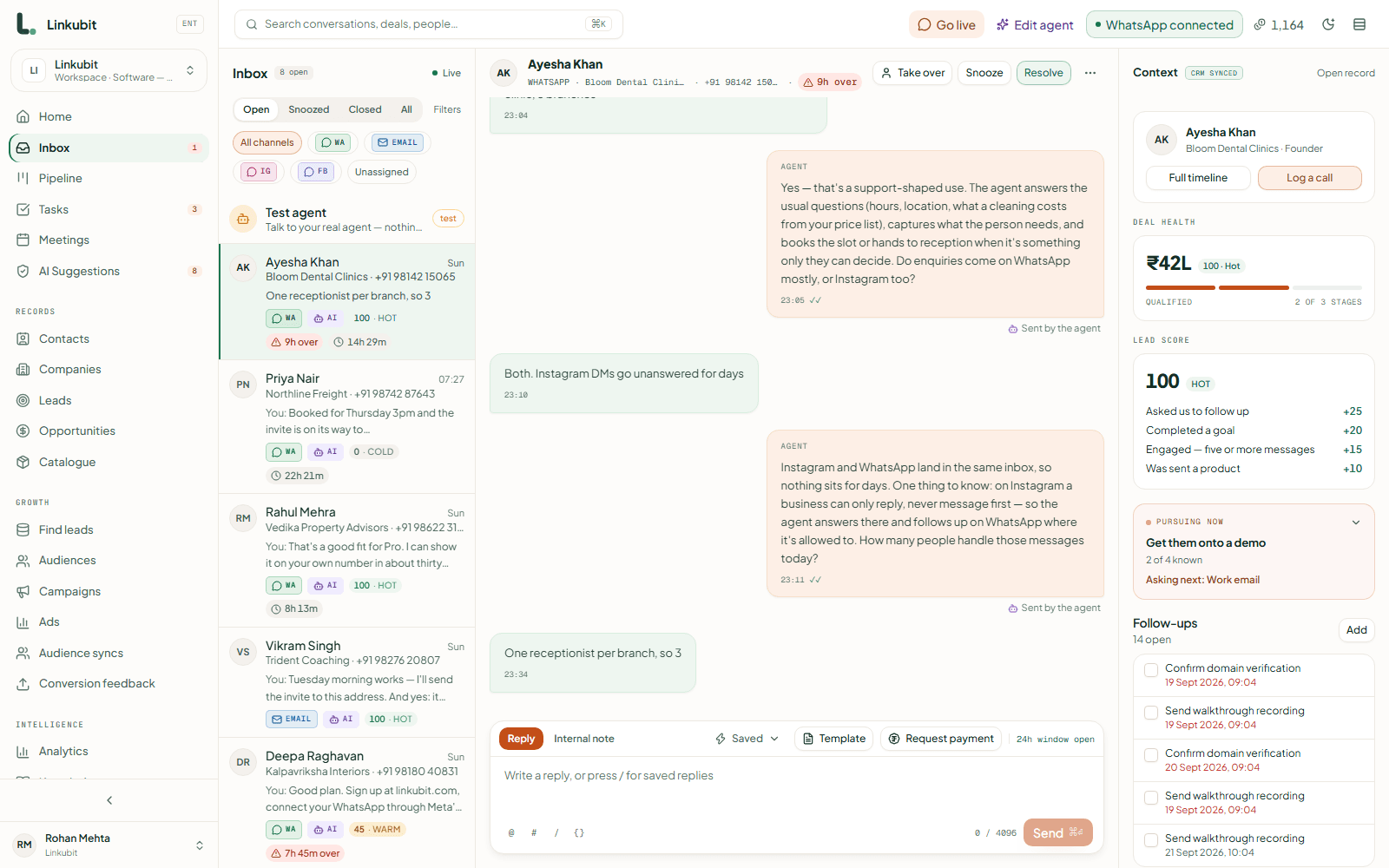
Linkubit’s inbox is the four channels in one queue, sorted by waiting time, with an owner on every thread, a collision warning, the window on every conversation, and a composer that only offers what the channel allows right now. The assistant answers first on every channel and hands over the way the section above describes; the person who takes over gets the contact, the answers and the reason. Instagram and Messenger connect in one click each from the Facebook Page; WhatsApp through Meta’s own signup; email from a domain you verify.
What it deliberately does not offer: an Instagram campaign, a Messenger broadcast, or an automation that uses the human-agent tag. Those are the things Meta forbids, and a product that pretended otherwise would be selling a send that fails.
Questions people ask
Can I send a marketing message on Instagram or Messenger?
No. Meta permits no business-initiated messaging on either — no templates, no campaigns. You can reply for 24 hours after a customer's last message, and a person (not an automation) can reply for seven days with the human-agent tag. WhatsApp and email are the channels for reaching out first.
Do I need a separate Instagram connection if I already connected Meta Ads?
The ad account and the DM inbox are different permissions. Instagram DMs come through the Instagram professional account linked to your Facebook Page; Meta Ads is one account across Facebook and Instagram placements. Linkubit connects each once.
Does an email thread and a WhatsApp chat from the same person become one conversation?
They become one contact with two conversations, each on its own channel with its own window rules, on one timeline. Merging identities is deterministic — the same email address or phone number, never a guess from a name — and every merge can be undone.
What happens when two reps open the same conversation?
A shared inbox has to say so. Linkubit shows who else has it open and who owns it; ownership is one person, and taking over from the AI claims it. Two people answering one customer is the failure the inbox exists to prevent.
Is a reply inside the 24-hour window free on every channel?
On Instagram and Messenger, yes. On WhatsApp, yes until 1 October 2026, then ₹0.115 a reply in India. Email has no window and no per-message fee from a network — only your provider's.
Read next
More on Inboxes and CRMsLinkubit vs other toolsWhatsApp templatesCost calculatorPricing
Try it on your own number. Linkubit answers, qualifies and quotes on WhatsApp from your catalogue, and adds nothing to Meta’s per-message price. Start free — fourteen days of Pro, no card — or read the pricing.