What is a WhatsApp CRM? What it has to do, what separates a good one from an inbox with a connector, and what it costs
Software that puts WhatsApp conversations on customer records so a team can share the number, see who is waiting, and follow up without losing anything. The seven things it has to do, the difference between an inbox and a revenue platform, and the two bills.
A WhatsApp CRM is software that puts a business's WhatsApp conversations on customer records — one contact per person, with their history, their fields, their stage in the pipeline and what they were sold — so a team can share the number, see who is waiting, and follow up without losing anything. The useful ones are built on the WhatsApp Business Platform, treat WhatsApp as one channel among several, and can act on the record: qualify, quote, book, collect.
The problem it solves
A business's WhatsApp starts as one phone. Then two people need it, so the phone is shared; then a lead who messaged last month asks about the quote, and nobody remembers which quote; then the owner wants to know how many enquiries came in last week, and the answer is "a lot". The WhatsApp Business app has labels and quick replies and stops there. A WhatsApp CRM is what you move to when the number has become the business's front door and the front door needs a record of who came through.
What it has to do
- One record per person. The same customer on WhatsApp, on email and on Instagram is one contact, with one history. Two records for one person is two people chasing them.
- A shared inbox with ownership. Who is handling this thread, how long has the customer waited, and is someone else already typing.
- Fields, not labels. Budget, locality, timeline, product — written as data a report can read and a rule can check, not as a tag on a chat.
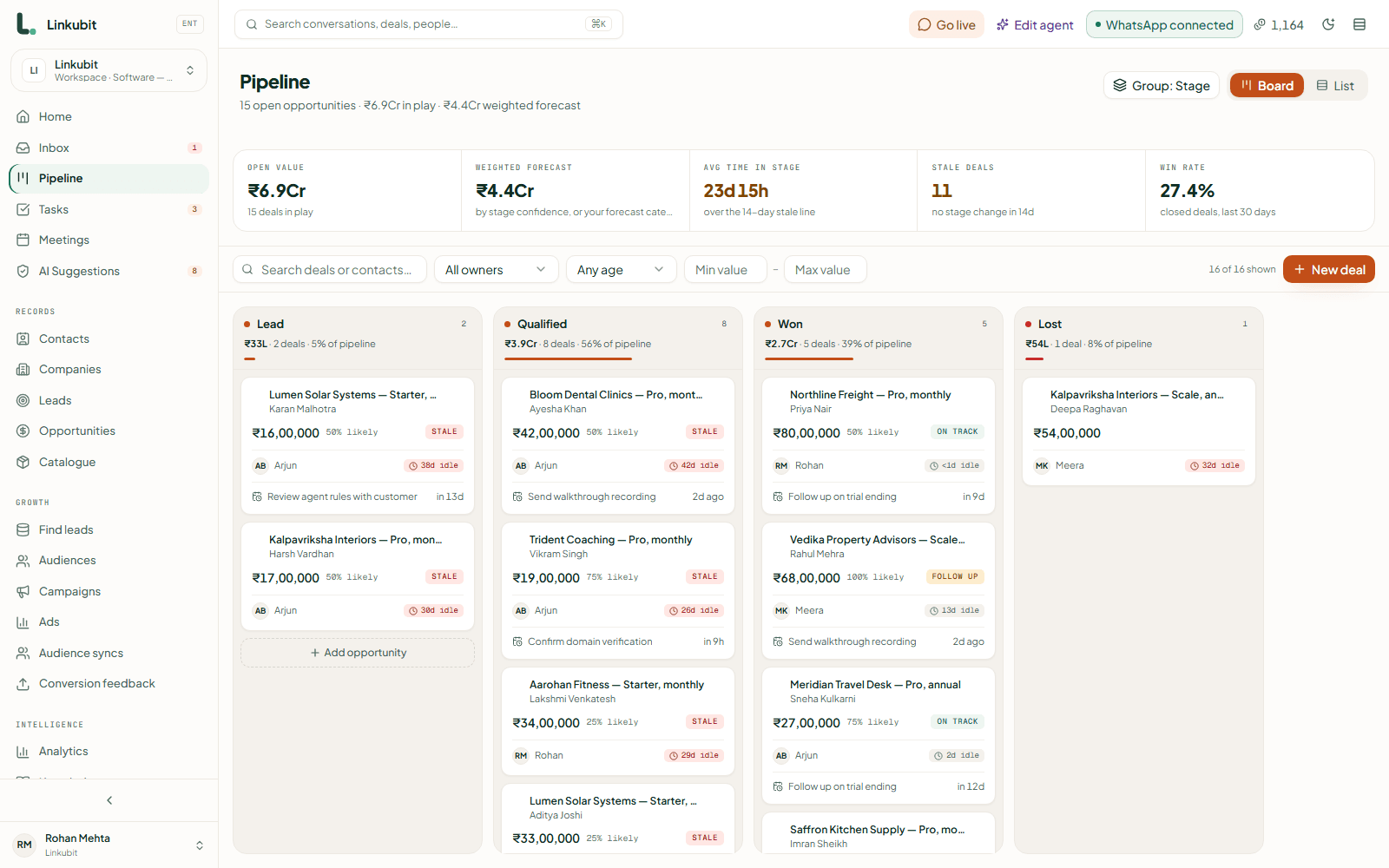
- A pipeline. Where each enquiry is — new, qualified, quoted, booked, won or lost — with stages that cannot be skipped.
- Consent and STOP. Who agreed to what, and a STOP that works everywhere at once. A CRM that lets you message a list is a CRM that gets your number banned.
- Templates and the window. The 24-hour rule enforced, templates approved and sent when their moment comes.
- Follow-up that stops when the customer replies. A sequence that keeps sending after a reply is spam with a schedule.
What separates the good ones
| An inbox with a CRM connector | A revenue platform on WhatsApp |
|---|---|
| Conversations here, customer records somewhere else, synced sometimes | The conversation is on the record; the record is what the AI reads and writes |
| Labels and notes | Fields a rule can check and a score can rank |
| A chatbot that sends the brochure | An AI that asks the qualifying questions, quotes from the catalogue, and hands over on a rule |
| Reports on messages sent | Cost per qualified lead and per won deal, attributed from the ad click |
| Payment links from another tab | A UPI payment request in the chat that closes the deal when paid |
What it costs
Two bills. Meta's, per message you start — ₹0.86 for a marketing message and ₹0.115 for a utility message to an Indian number, plus, from 1 October 2026, a fraction of a rupee per reply. And the software's — a subscription that ranges from free to tens of thousands of rupees a month, sometimes with a mark-up on Meta's rate hidden inside it. The pricing guide has Meta's card; the comparisons show what each tool adds.
Linkubit
One customer graph across WhatsApp, email, Instagram DM and Messenger; an AI salesperson that qualifies, quotes from the catalogue and opens the deal; a pipeline whose stages refuse illegal moves; consent and suppression enforced on every send; attribution from the ad click; UPI in the chat. Free to start, ₹499 a month for a team, nothing added to Meta's rate.
Is the WhatsApp Business app a CRM?
No. It has labels, quick replies and a catalogue, for one person on one phone. It cannot be shared, automated or reported on, and it holds no customer record beyond the chat.
Do I need the WhatsApp Business API for a CRM?
Yes. A CRM that reads and writes your WhatsApp messages runs on the Business Platform (the API); the app has no way to hand messages to software. Getting it takes about ten minutes.
What is the best WhatsApp CRM for a small business in India?
It depends on what you sell. This guide compares eight tools on price, per-message charges, AI and channels, with every figure from the tool's own pricing page.
Read next
More on Inboxes and CRMsLinkubit vs other toolsWhatsApp templatesCost calculatorPricing
Try it on your own number. Linkubit answers, qualifies and quotes on WhatsApp from your catalogue, and adds nothing to Meta’s per-message price. Start free — fourteen days of Pro, no card — or read the pricing.