Speed to lead on WhatsApp: why the first minute decides the sale, and how to reply in it every time
A property or freight enquiry answered in a minute is a conversation; one answered in the morning is a lead someone else met. What to say in the first message, what to ask, and how to follow up without becoming noise.
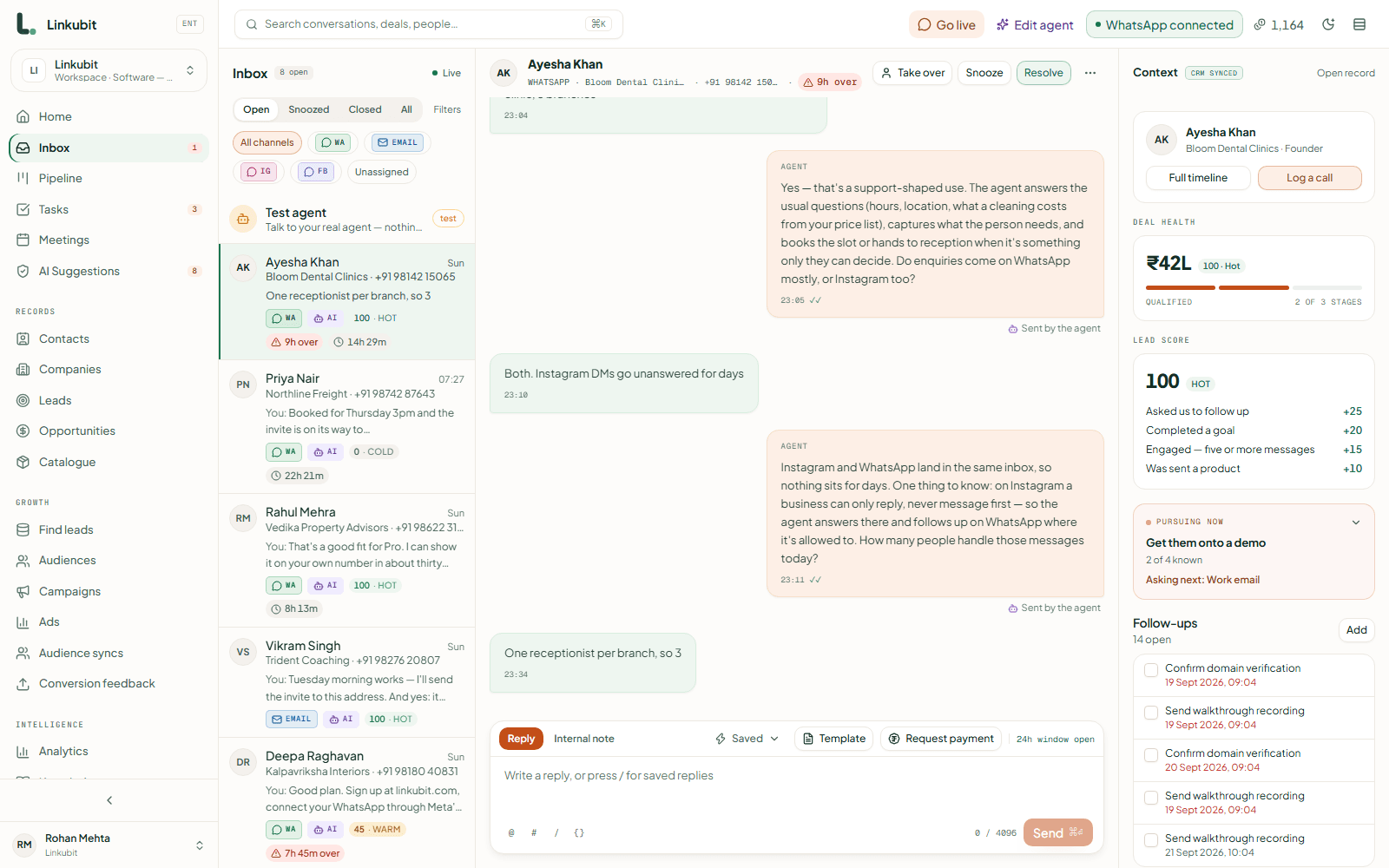
A lead answered inside a minute is a conversation; one answered in the morning has already been met by someone else. The first message should use their name, restate what they asked, and ask one or two specific questions — never "how can I help". Qualify before you quote, follow up once with something they asked for, and automate the first minute and the reminders, not the negotiation.
On this page
The first minute
A lead that arrives on WhatsApp — from a portal, a Click-to-WhatsApp ad, a saved number — is a person with their phone in their hand, right now, choosing between three businesses they have just messaged. Whoever answers first, with something that shows they read the message, is the one the lead keeps talking to. The other two get a “sorry, already sorted” or, more often, nothing.
This is not a claim about attention spans. It is how a person shortlists. They message three; one replies; that one gets the follow-up questions, the site visit, the shipment. The lead is not lost at day three. It was decided in the first minute.
What the first message says
Four things, in this order, in three lines:
- Their name. A lead form gives it to you; use it.
- What they asked about, restated. “Thanks for your interest in Skyline Business Park”, “we have your rate request for Nhava Sheva to Jebel Ali”. This proves the message was read, which is the entire reason they will reply.
- Who you are. A name, not a brand. “I am Anil from Meridian Realty and I will be your point of contact.”
- One or two specific questions. The ones your business actually needs answered next: size and move-in date; commodity and monthly volume. Not “how can I help you” — that asks the lead to type their message again.
Two ready-made versions: property enquiry received and freight quote request received. Both go out inside the window the lead just opened, so both are free.
Ask before you pitch
The temptation after a fast reply is a fast pitch: the brochure, the rate card, the shortlist. Sent before you know the budget or the volume, it costs you a day and the lead’s confidence — options at ₹85 a square foot to someone with ₹30, a container rate to someone shipping two pallets.
Qualify first. Every business has four to six questions a lead must answer before a quote is worth writing. Ask them in the conversation, one or two at a time, in the lead’s language, and write the answers down somewhere a report can find them — not in the chat. A lead with those fields filled is a lead a person can act on in one look. That is the whole difference between an inbox and a pipeline.
A rule, not a habit
The businesses that do this reliably do not rely on discipline. They make the quote impossible until the fields are filled — a rule in the tool, not a reminder to the team. Linkubit’s qualification works that way: the assistant cannot reach the quotation until lane and volume, or size and budget, are on the record.
Following up without becoming noise
Inside the 24-hour window, follow up as the conversation needs — you are answering someone who is talking to you. It is after the window closes that businesses either go silent or become noise. The middle path:
- Once, with something they asked for. The quote, the shortlist, the visit slot — as a utility template, with the substance in the message. A follow-up that carries nothing (“just checking in!”) is a charge and a nudge with no reason to reply.
- Then a real gap. A week for property, a few days for freight. A second message with a new reason: the visit slot is closing, the rate is valid until Friday.
- Then stop, and mark it. Two unanswered follow-ups is an answer. Mark the lead cold so nobody messages them again next month, and let a single check-in thirty days later — one, with a STOP line — be the last word.
The template library has the follow-ups for both verticals — after the visit, proposal sent, quote ready, delay notice — each with a note on when it is a utility message and when it has crossed into marketing.
The window, and what it costs
On WhatsApp the 24-hour window is both the rule and the price. Inside it you can send anything; outside it, only an approved template, charged by category. Until 1 October 2026 replies inside the window are free; from that day Meta charges ₹0.115 each in India. The pricing guide has the full rate card.
Two consequences for follow-up. First, the cheapest follow-up is the one that keeps the window open — answer fast enough and the conversation never closes. Second, after October a reply that says nothing is a reply that costs something: five messages where one would do is five charges. Say the whole thing in one message.
What to automate, and what not to
| Automate | Keep for a person |
|---|---|
| The first reply, inside a minute, on every channel, at any hour | The negotiation |
| The qualifying questions, and writing the answers to the record | The site visit, the site survey |
| Confirmations, reminders, milestone updates | A complaint, a hazardous shipment, anything you named as needing a human |
| The one follow-up that carries what they asked for | The second follow-up, if there is a real reason for it |
| Marking a lead cold after two silences | Deciding to call |
The dividing line: automate what has to happen fast or has to happen every time, and keep for a person what needs judgement. An assistant that does the left column and hands over for the right — with the record attached — is what Linkubit is built to be. It is free for one number; connecting it takes a few minutes.
Questions people ask
How fast should a business reply to a WhatsApp lead?
Inside a minute while the lead is still on the phone and still deciding who to trust. After an hour the lead has asked two other businesses; after a day they have met one of them. The first reply does not have to be the answer — it has to be a real question that shows you read the message.
What should the first reply to a lead say?
Their name, what they asked about, who you are, and one or two specific questions that move it forward — "what size, and when do you need to move in?" for property; "what are you shipping and where to?" for freight. Not "how can I help you", which asks the lead to repeat themselves.
How many times should I follow up a lead on WhatsApp?
Inside the 24-hour window, as often as the conversation needs. After it closes, once with a utility template that carries something they asked for — a quote, a shortlist, a visit time — and then once more after a real gap. Three unanswered nudges in a week is a block, not a sale.
Is it better to follow up on WhatsApp or by phone?
WhatsApp first: it is read, it is answered when convenient, and it leaves a record. A call is for when the lead has asked for one or the deal needs a negotiation. A missed call followed by "tried calling you" on WhatsApp is the worst of both.
Can an AI do the first reply?
Yes, and it should — it is the one reply that cannot wait for a person. What matters is what it does after: writes the answers onto the lead, refuses to quote until it has what it needs, and hands a hot lead to a named person with everything attached. From 1 October 2026 each reply costs ₹0.115 on WhatsApp, so an AI that answers in one message beats one that answers in four.
Read next
More on Getting and keeping leadsLinkubit vs other toolsWhatsApp templatesCost calculatorPricing
Try it on your own number. Linkubit answers, qualifies and quotes on WhatsApp from your catalogue, and adds nothing to Meta’s per-message price. Start free — fourteen days of Pro, no card — or read the pricing.